Pool heater installation, sized to your pool
We install gas heaters and electric heat pumps across Brevard County. It starts with size: your pool's surface area and the warmth you want.
- State-licensed for the pool work and the gas line
- 98 Google reviews, 5.0
- Pool
- 20,000 gal, 5 ft average depth gal, ft average depth
- Surface
- 535 sq ft
- Temperature rise
- 20°F °F
- Heater output
- 128,400 BTU/hr
Type your pool into the plate. Rise is the water temperature you want minus the coldest swim month's average air.
U.S. Department of Energy formula. See the sizing chart
Should I repair or replace my pool heater?
Repair it when the fault is a replaceable part and the heat exchanger and cabinet are sound. Replace it when the exchanger leaks, the same failure keeps coming back, or the parts are no longer made.
Usually a repair
- A sensor, switch or high limit
- An ignitor or flame sensor
- A blower motor
- A control board that is still made
- A fault in the low-voltage wiring
Usually a replacement conversation
- A leaking heat exchanger
- A second exchanger failure on the same heater
- Corrosion through the firebox or cabinet
- A control board that is no longer made
- A heater that no longer fits how you use the pool, such as a new spa on the pad
Age alone doesn't decide it. The U.S. Department of Energy says gas heaters typically last five or more years, and heat pumps ten or more.
We weigh what failed, what's already been replaced, the cabinet and internals, and whether parts are still made.
Still repairable? See what we check on a repair. Comparing prices? See installation cost.
Lifespans: U.S. Department of Energy, Energy Saver, "Gas Swimming Pool Heaters" and "Heat Pump Swimming Pool Heaters" (archived).
How many BTU do I need to heat a 20,000-gallon pool?
About 128,000 BTU per hour of output, for a 20°F rise. That's the U.S. Department of Energy's formula on about 535 square feet of surface, at a 5-foot average depth.
Work yours out in five steps
Surface area (sq ft) × temperature rise (°F) × 12 = BTU per hour of heater output
| Pool surface | 10°F rise | 15°F rise | 20°F rise | 25°F rise |
|---|---|---|---|---|
| 300 sq ft | 36,000 | 54,000 | 72,000 | 90,000 |
| 400 sq ft | 48,000 | 72,000 | 96,000 | 120,000 |
| 500 sq ft | 60,000 | 90,000 | 120,000 | 150,000 |
| 535 sq ft 20,000 gal, 5 ft average depth | 64,200 | 96,300 | 128,400 (the 20,000-gallon example) | 160,500 |
| 600 sq ft | 72,000 | 108,000 | 144,000 | 180,000 |
| 800 sq ft | 96,000 | 144,000 | 192,000 | 240,000 |
Shaded: the 20,000-gallon example at a 20°F rise.
Formula: U.S. Department of Energy, Energy Saver, "Heat Pump Swimming Pool Heaters" and "Gas Swimming Pool Heaters" (archived).
- Pick the water temperature you want.
- Find the average air temperature for the coldest month you plan to swim.
- Subtract step 2 from step 1. That is your temperature rise.
- Measure the surface in square feet. For a rectangle, that is length × width.
- Multiply surface × rise × 12.
The formula assumes the water gains 1°F to 1¼°F an hour, with a 3½ mph breeze across the surface. To gain 1½°F an hour, multiply the result by 1.5; to gain 2°F, multiply by 2.
Wind, low humidity and cool nights all raise the load, so an exposed pool needs a bigger heater.
How small a heater can I get away with?
Smaller means slower: the pool gains less than about 1°F an hour. Wind and cool nights widen the gap.
Bring these numbers to the call
Pool volume, surface area, enclosure, target temperature, and whether a spa shares the equipment pad.
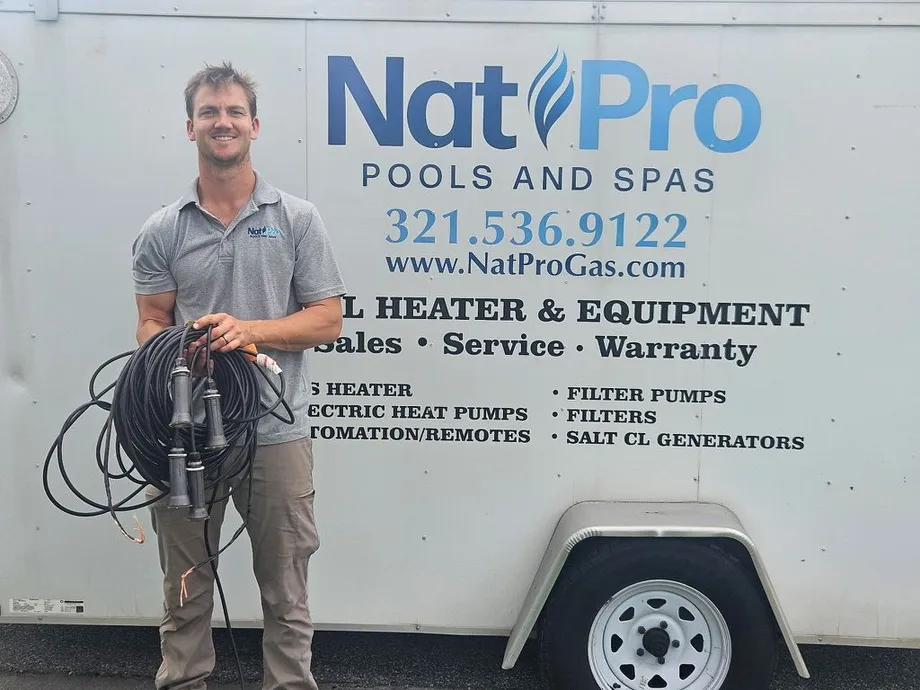
"Thank you Nat/Pro for your prompt service, reasonable cost, and expert installation. Your team arrived on time, worked quickly and even hauled away our old equipment. They were helpful in explaining how to work the system."
Which pool heater should I buy?
No single brand is best for every pool. Pick the fuel, size it to your surface area, then compare output, efficiency, exchanger metal and warranty.
Gas heats quickly and suits planned swims. A heat pump costs more to buy and usually far less to run. Side by side: gas or heat pump.
What to compare between two heaters
| Compare | Why it matters | Where to find it |
|---|---|---|
| Rated output | It is the number the sizing formula gives you. Gas heaters are labeled by input instead. | Heat pumps: the rating. Gas: input × efficiency. |
| Efficiency | Gas heaters state thermal efficiency as a percentage. Heat pumps state COP, which usually runs 3.0 to 7.0. | The nameplate, or the manufacturer. |
| Heat exchanger metal | Salt and water chemistry decide what lasts. Some makers offer cupro-nickel. | The manual's water-chemistry table. |
| Warranty conditions | Improper installation can void a manufacturer warranty. | The warranty sheet and the install manual. |
| Controls | The heater should talk to your automation. Jandy's JXi manual documents AquaLink RS remote operation. | The install manual. |
Does a salt pool need a different heat exchanger?
Not always. Pentair's MasterTemp handles chlorine, bromine or salt pools up to 5,000 ppm salt. Outside the manual's chemistry limits, the exchanger can fail early and the warranty is void.
Lochinvar lists a cupro-nickel exchanger as an option on its EnergyRite heaters. Check the chemistry table for the model you're quoted.
Source: Pentair, MasterTemp installation and user's guide.
Hayward, Pentair or Raypak? At the same size, compare the specs, not the badge. Already own one? Each brand page covers its models and faults:
"Service was very prompt, I appreciated them answering all my questions and helping me understand the difference between the various products. I will continue to use Nat/Pro because of their excellent work."
What electrical service does a heat-pump pool heater need?
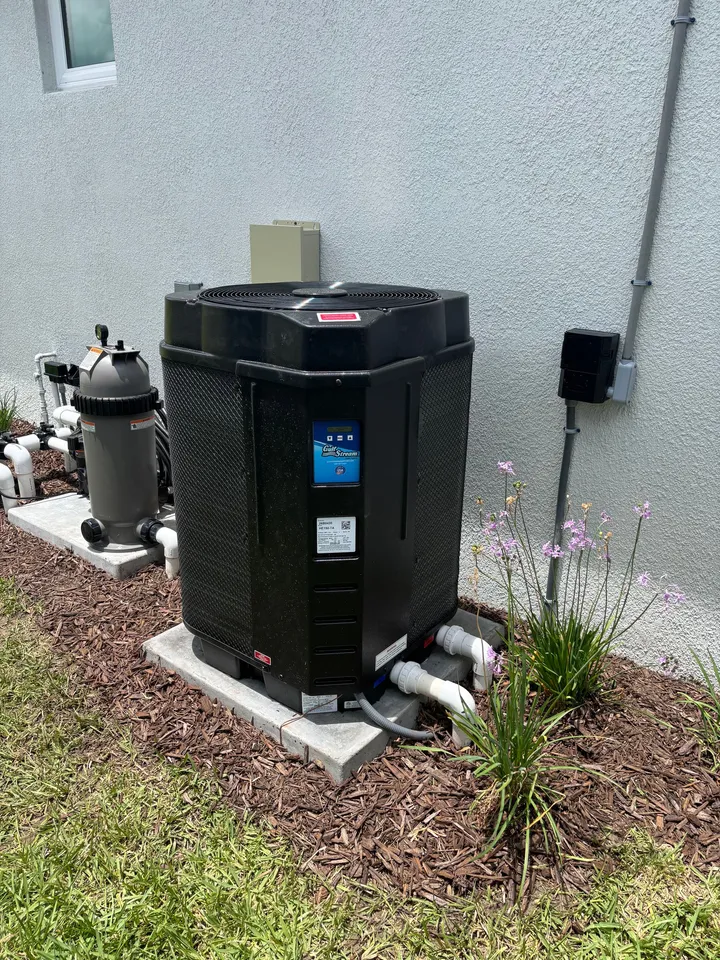
A circuit sized to the heat pump's nameplate. In Florida, a licensed electrical contractor installs or upgrades it.
Some units, like Hayward's Generation 5 heat pumps, run on 230/240 volts only. Have an electrician confirm the panel, breaker and wire before you buy.
What the circuit adds to a quote: installation cost.
Can I install a pool heater myself?
Not a gas heater. Pentair's MasterTemp manual requires a qualified professional, and improper installation voids the warranty.
The gas piping needs its own license. We're state-licensed for both the pool work and the gas line — see the license records.
Ready to plan yours? Call (321) 536-9122 or schedule service. Schedule Service or call (321) 536-9122.
How an installation runs
-
Share details
Use the form or call about your install or replacement.
-
Review the fit
We talk through pool, spa, sizing, fuel and site.
-
Confirm the quote
You see the equipment and scope before anything is ordered.
-
Set the date
Once you approve the quote, we book the install.
What the quote covers
- Pool, or pool and spa, sized to how you actually swim.
- Sizing inputs: volume, surface area, enclosure, target temperature and warm-up time.
- Gas or electric heat pump, matched to your utilities.
- A site-specific installation or replacement quote.
- Most installs include a manufacturer warranty.
If a heat pump needs a new circuit, an electrician runs it — we'll tell you what it needs.
Pump or filter due too? We can replace it on the same job.
What moves the price: installation cost.
Plan your heater installation
Can't call right now? Send the details and we'll call you back.
Put both yearly tune-ups on the Maintenance Club.
$27.50 a month or $275 a year (two months free), with priority service and 20% off repair labor. See what's included →
Get more swim time
Call us about installing or replacing a pool or spa heater anywhere in Brevard County. Monday–Friday, 8am–5pm; closed weekends.
We serve all of Brevard County, Florida. See every Brevard service area.